A Working Definition

What Is a
Stolen Election?

★ ★ ★

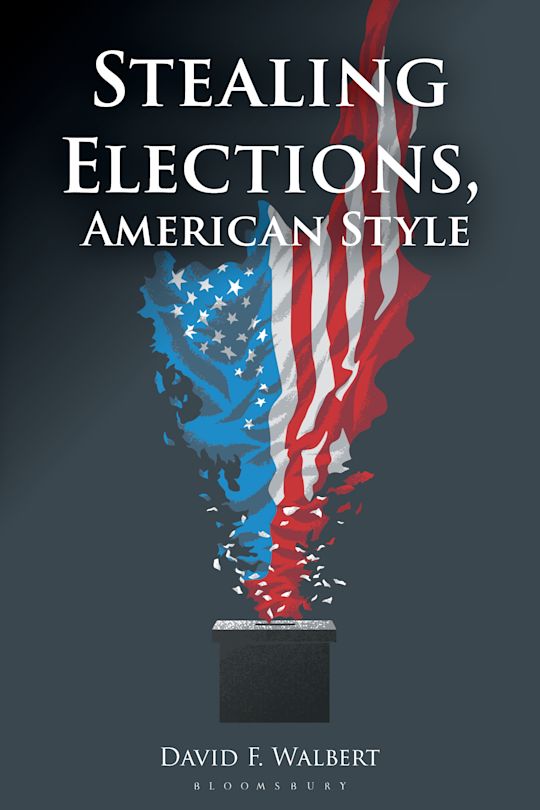
A companion to Stealing Elections, American Style by David F. Walbert (Bloomsbury Academic)

The short version

An election is stolen when those with power engineer the result — through fraud in the count, or, far more often, through rules rigged in advance — so the outcome no longer reflects the freely-expressed will of the eligible people. “Vastly more elections are stolen before a single ballot is cast through rules that predetermine the outcome.”

01 Two ways it happens

Fraud is the one everyone pictures. Rigging the rules is the one that actually decides most elections.

Outright fraud

Theft in the casting or counting — ballot-box stuffing, “lost” ballots, buying votes, fake returns, corrupt counts. Risky, catchable, comparatively rare.

Rarer · riskier

Rigging the rules

Theft before a ballot is cast — gerrymandering, voter suppression, and laws that stack the deck. Quiet, legal-looking, and “more reliable than outright fraud.”

The main event

02 The tools of rigging

The recurring ways power is used to tilt an election before — or as — the votes are counted.

Each of these is, on its own, a tool for tilting an election. We don't tally them, and we don't tell you where the line falls. How many it takes to call an election stolen — and which of them cross your own moral line — is yours to decide. Our job is only to name them plainly and show how each one works.
  1. Predetermination

    The outcome is fixed in advance — the election is decided before the first vote is cast — instead of leaving voters a real choice.

    In the book: gerrymandering as “the ultimate political game of rigging elections before voters cast their ballots.”

  2. Rule-makers serving themselves

    The people who benefit control the machinery: elected officials choose their voters instead of voters choosing their representatives. The referee is also a player.

    Scholarly anchor: Foley on “excessive partisanship” — officials overseeing contests their own party competes in.

  3. A false pretext

    The stated reason is untrue or evidence-free — a law sold as stopping “fraud” that barely exists. The justification itself is the real fraud.

    Legal anchor: the Arlington Heights / NC NAACP v. McCrory purpose analysis — a law struck for targeting voters “with almost surgical precision.”

  4. A burden out of scale with the problem

    It blocks or dilutes many legitimate voters to solve a vanishingly small real problem — e.g. Kansas blocked 31,000+ eligible applicants to catch about 39 noncitizens over 20 years.

    Legal anchor: the Anderson–Burdick balance — the burden on voters weighed against the genuine state interest.

  5. A designed, asymmetric effect

    The skew against one side's voters is a feature, not an accident — and it is measurable: packing and cracking, party-line enactment, a lopsided seats-to-votes gap.

    Anchor: the VRA §2 results test; the efficiency gap (presumptive at 2 seats / 8%).

  6. Seizing the machinery itself

    Capturing the boards, courts, or officials that certify results — claiming discretion to refuse to certify, to “find” votes, or to declare an outcome uncertain.

    In the book: the newest tactic — sabotaging fair elections “by outright seizing the election machinery of the states.”

03 What is not a stolen election

The honest boundaries. Naming what rigging is not is what keeps this a description of theft — not of rules we happen to oppose. The book insists on these too.

Two accuracy notes for the site: the strongest, unassailable ground is the documentary-burden and fraud-rarity data — the voter-ID turnout literature is genuinely mixed. Noncitizen voting and in-person impersonation are documented as vanishingly rare, which is exactly what makes the “false pretext” tool so easy to spot.

The full story

This is the short version.
The whole history is in the book.

Two centuries of stolen elections — the schemes, the court fights, and what comes next — told in full.

Read Stealing Elections, American Style
★ ★ ★
Sources & grounding

Book: David F. Walbert, Stealing Elections, American Style (Bloomsbury Academic, 2026) — Preface and Chs. 5, 7, 9, 10.

Electoral integrity: Pippa Norris, Why Elections Fail (Cambridge, 2015) & the Electoral Integrity Project. electoralintegrityproject.com

Typologies of manipulation: Sarah Birch, Electoral Malpractice (Oxford, 2011); Andreas Schedler, “The Menu of Manipulation,” J. of Democracy 13(2), 2002.

Suppression vs. legitimate regulation: Daniel Tokaji, “The New Vote Denial,” 57 S.C. L. Rev. 689 (2006); Richard Hasen, Election Meltdown (Yale, 2020); Edward Foley, “Due Process, Fair Play, and Excessive Partisanship,” 84 U. Chi. L. Rev. 655 (2017).

Legal tests: Anderson v. Celebrezze (1983) / Burdick v. Takushi (1992); Village of Arlington Heights (1977); NC State Conf. of the NAACP v. McCrory, 831 F.3d 204 (4th Cir. 2016); VRA §2 / Thornburg v. Gingles (1986).

Gerrymandering metrics: Stephanopoulos & McGhee, “Partisan Gerrymandering and the Efficiency Gap,” 82 U. Chi. L. Rev. 831 (2015); Rucho v. Common Cause (2019).

Proof-of-citizenship & fraud data: Fish v. Kobach / Fish v. Schwab (D. Kan. 2018; 10th Cir. 2020); Brennan Center, Citizens Without Proof (2006) & noncitizen-voting analysis (2017); Justin Levitt, The Truth About Voter Fraud.

Turnout (mixed evidence, presented honestly): GAO-14-634 (2014); Hajnal, Lajevardi & Nielson, J. of Politics (2017); Cantoni & Pons, QJE (2021).